
Infrastructure strategy
The Hidden Costs in Your Capital Budget: How Design Reveals the Full Project Cost
Why early project definition helps facility and procurement teams build more accurate, defensible capital budgets.
Facility managers are often asked to do something difficult.
Identify the right solution for a critical system, determine what it will cost, and secure the capital budget to replace it, sometimes one or two years before the project will actually happen.
At the same time, they are under pressure to control costs.
The system needs to be reliable. The project needs to meet operational requirements. The budget needs to be accurate. And the upfront cost of getting there needs to be kept as low as possible.
The challenge is that funding for design and engineering may not yet be available. Those costs can be difficult to justify in the current fiscal year when the larger project itself may still be one or two years away.
So facility and procurement teams often turn to the resource already available to them: trusted contractors.
That can work well for straightforward projects. An experienced contractor can provide valuable insight into equipment selection, installation requirements and current market costs.
But as projects become more complex, there is a limit to how much risk can reasonably be transferred to contractor budgeting alone.
A contractor may have deep expertise in their equipment and trade while not being responsible for the broader engineering review needed to identify every interface with electrical systems, controls, structures, life-safety systems and other disciplines.
The result is not necessarily poor planning.
It can simply be a project that was asked to produce a reliable capital number before enough funding was available to properly define it.
01The budgeting paradox
Most capital projects begin long before equipment is ordered.
A facility manager may know that a chiller, UPS, generator or other critical system will need to be replaced within the next few years. Finance needs a number so the project can be incorporated into the capital plan.
But there is a problem.
Developing an accurate number requires understanding the project.
And understanding a complex project often requires some level of investigation and design.
That work costs money today, while the actual project may not be funded until a future fiscal year.
It can be tempting to defer the design work and simply ask several contractors for budget pricing.
For straightforward projects, that may be entirely appropriate.
For more complex projects, it can create a false sense of budget certainty.
02Equipment pricing is not a project budget
Suppose a facility needs to replace a major piece of infrastructure, such as a chiller, electrical distribution system, UPS, controls platform, pumping system or other critical building equipment.
It is relatively easy to obtain the cost of the equipment.
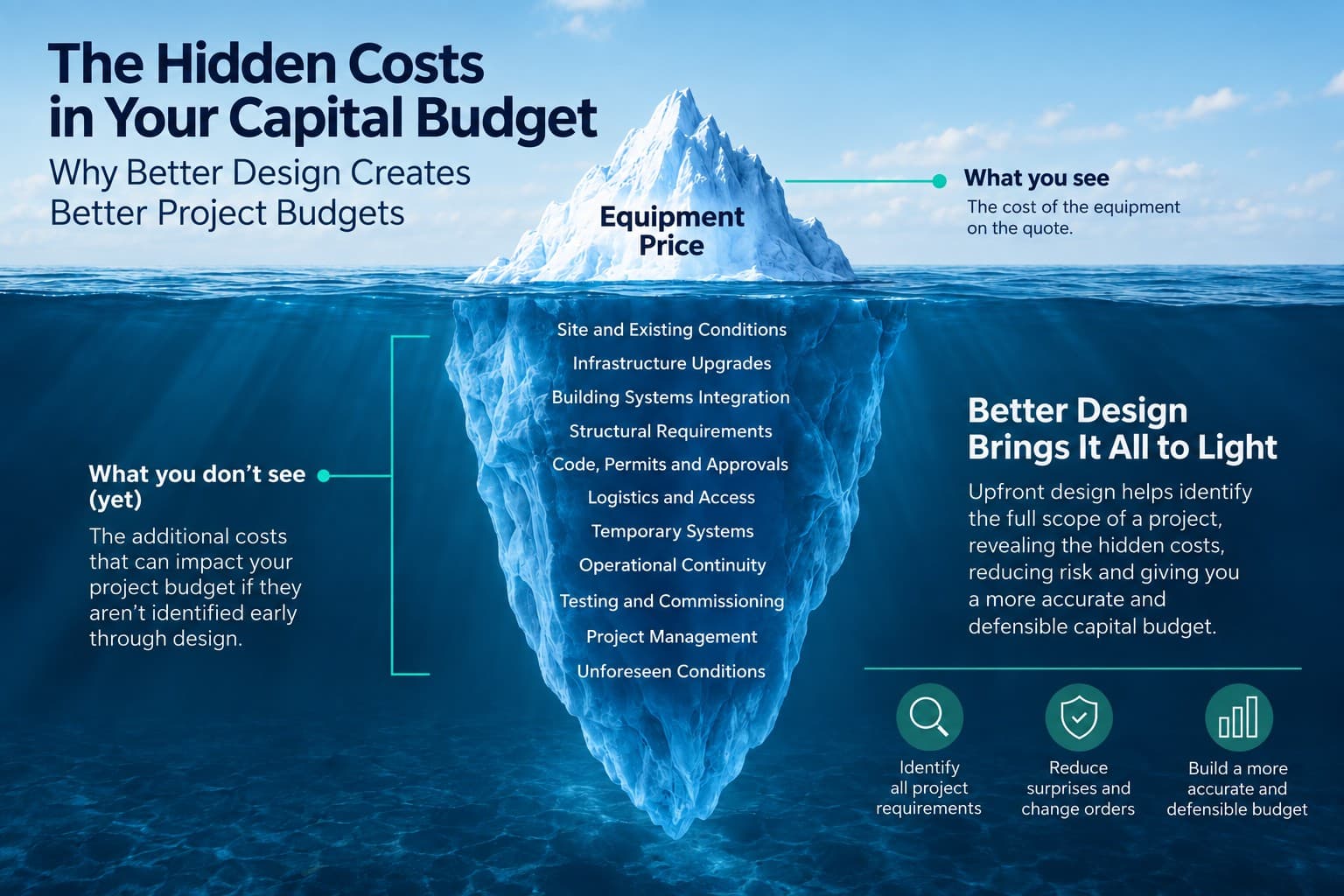
But the equipment is only one part of the project.
What happens if the replacement has different electrical, mechanical or plumbing requirements? Can the existing infrastructure support it? Will controls or other building systems need to be integrated? Are structural modifications required? Are there code or life-safety implications? Can the old equipment be removed and the new equipment brought into position? What needs to happen to keep the facility operational during the replacement?
Those questions have costs attached to them.
If they have not been answered, they have not disappeared.
They are simply unresolved costs sitting outside the budget.
03Why contractor budgeting has limits
A common approach is to send an equipment list or basic project description to several trusted contractors and ask them to provide budget pricing.
There is good reason for this. Contractors often understand the existing facility, know the equipment, understand installation methods and have current knowledge of labor and material costs. For straightforward projects, their experience may provide exactly what is needed to establish a reasonable budget.
The challenge comes when the project extends beyond the contractor's primary trade or scope.
A contractor may understand their equipment, trade and installation methods exceptionally well but may not be responsible for evaluating every other system affected by the project. A mechanical contractor may identify the mechanical requirements while electrical distribution, controls, structural, plumbing or life-safety interfaces require separate review. The same principle applies across electrical, controls, plumbing and other specialty trades.
This is not a shortcoming of the contractor. It is a difference in role.
As projects become more complex, relying on individual contractors to independently identify and price every project interface can leave gaps between scopes.
When information is missing, contractors generally have two choices: make an assumption or exclude the item from their scope.
Those assumptions and exclusions matter.
The exclusions may be clearly stated in the proposal.
The challenge for a facility or procurement team is understanding their full implication.
A facility manager is not expected to design mechanical, electrical, controls, plumbing, structural and life-safety systems every day. A procurement professional should not be expected to recognize every technical interface hidden behind a one-line exclusion.
The proposal may therefore look complete while significant portions of the eventual project cost remain undefined.
That becomes particularly difficult when the number is carried into a future capital budget as though it represents the complete project.
04The lowest upfront cost can create a more expensive problem later
This is where reducing engineering costs can become counterproductive.
Imagine that a facility receives preliminary contractor pricing and uses it to secure funding for the following fiscal year.
Twelve months later, the project is approved.
Now the detailed work begins.
The electrical system needs to be upgraded. Controls integration was excluded. Additional infrastructure is required. The equipment requires a different rigging strategy. A shutdown needs temporary equipment or additional phasing.
None of those requirements were included in the original budget.
The facility manager now has a project that may be technically necessary but financially underfunded.
The result can be a request for additional capital, a reduction in project scope, a delay while additional funding is secured, or pressure to find savings somewhere else in the project.
The engineering cost that appeared unnecessary a year earlier may have been relatively small compared with the financial uncertainty it could have helped identify.
05Not every project needs the same level of engineering
That does not mean every equipment replacement requires a full engineering design package.
The level of planning should be proportional to the complexity and risk of the project.
A straightforward like-for-like equipment or system replacement may only require site verification, confirmation of capacities and connections, installation planning, and a clearly defined scope.
A retrofit involving changes in equipment capacity, technology, configuration or supporting infrastructure requires more investigation. Electrical, mechanical, plumbing, controls, structural requirements and system operation may all need to be evaluated before a reliable project budget can be developed.
A major infrastructure project may require formal engineering calculations, coordinated drawings, specifications, code review, sequencing, commissioning requirements and professional engineering involvement.
The objective is not to add engineering for the sake of engineering.
It is to complete enough design work to understand the project at the level of accuracy required for the decision being made.
06Match the planning effort to the project
A useful way to think about infrastructure projects is in three general levels.
- 01Level 1: Straightforward Replacement
The equipment or system is being replaced with a similar product, capacity and configuration, with minimal changes to the supporting infrastructure.
The focus should be on field verification, equipment selection, connection requirements, installation logistics and a clearly defined scope. Full engineering may not be necessary.
- 02Level 2: System Retrofit
The replacement changes capacity, technology, configuration or the way the equipment or system interacts with the facility.
Additional technical review may be required for electrical, mechanical, plumbing, controls, structural, life-safety or other interfaces. At this level, investing in design before establishing the final capital budget becomes increasingly important.
- 03Level 3: Integrated Infrastructure Project
The project affects multiple building systems, introduces significant new capacity, changes system architecture, requires major modifications or involves critical operations.
These projects benefit from a more formal engineering process before construction pricing is treated as a reliable project budget. The greater the number of interfaces, the greater the opportunity for something important to be missed.
The objective is not to apply the same process to every project. It is to match the planning effort to the complexity, interfaces and consequences of getting the budget wrong.
07Design is part of budget development
This is the mindset that often needs to change.
Design should not always be viewed as an expense that begins after a project has been approved.
For larger projects, part of the design effort belongs in the fiscal period before the major capital expenditure.
If a facility expects to replace a major system next year, allocating a smaller amount of funding this year for assessment and design can provide the information needed to build a much more defensible capital request for next year.
That changes the conversation with finance.
Instead of saying, "We think the project will cost approximately this much," the facility team can explain what has been evaluated, what infrastructure modifications are required, what assumptions remain, what risks have been identified and what the resulting project budget includes.
The objective is not perfect foresight.
Unexpected conditions can still occur, particularly in existing buildings.
The objective is to identify the things that reasonably could have been known before the capital budget was established.
08Better design also creates better bids
There is another benefit.
When contractors receive a well-defined project, they are more likely to be pricing the same work.
Without a defined scope, one contractor may include electrical modifications while another excludes them. One may include controls integration while another assumes it will be provided by others.
The lowest proposal may simply contain the fewest included requirements.
That makes procurement difficult because the apparent price difference may not actually represent a difference in value or efficiency.
Better project definition gives procurement teams a more consistent basis for comparison.
Instead of trying to determine what each contractor assumed, they can focus more attention on the things they should be evaluating: execution approach, schedule, experience, commercial terms and price.
09Engineering does not eliminate risk. It makes more of it visible.
No amount of planning can identify every condition inside an existing facility.
Walls get opened. Undocumented modifications are discovered. Existing equipment does not always match old drawings. Conditions change between design and construction.
Good planning does not promise to eliminate those risks.
It helps separate genuinely unforeseen conditions from requirements that could reasonably have been identified before the project was funded.
That distinction matters, especially when a facility manager has to explain a capital variance to finance or senior management.
10Spend earlier to plan better
Facility teams are expected to balance two competing responsibilities.
They need to control costs.
They also need to deliver systems that perform reliably.
Those objectives are not necessarily in conflict.
The key is understanding where cost reduction actually creates value and where it simply transfers cost and risk further into the project.
For a straightforward equipment or system replacement, extensive engineering may add little value.
For a complex retrofit or major infrastructure project, however, reducing design effort to save money during the current fiscal year can create a much larger budgeting problem in the next one.
At nuValence, we approach project development by first understanding the facility, the existing infrastructure and the operational requirement. From there, the level of design and engineering can be matched to the complexity of the project, with the appropriate engineering resources engaged where required.
The goal is not to make every project more complicated.
It is to define the project well enough that the equipment selection, project budget and eventual construction scope are based on the same understanding.
Because when the capital request reaches the budget meeting, the most important number is not necessarily the lowest one.
It is the one you can explain.
Frequently Asked Questions
No. The appropriate level of engineering depends on the complexity and risk of the project. A straightforward like-for-like equipment or system replacement may require field verification and installation planning rather than a complete engineering design. Projects involving changes in capacity, system configuration, electrical or mechanical infrastructure, controls, plumbing, structural requirements or multiple building systems generally require greater technical review.
For larger projects, early investigation and design help establish what the complete project is likely to require. This allows the facility team to develop a more informed capital budget before requesting funding for construction.
Yes. Preliminary contractor pricing can be useful during early planning. The important consideration is understanding the assumptions, allowances and exclusions behind the number and not treating preliminary pricing as a fully defined construction budget.
A defined scope gives contractors a more consistent basis for pricing. This reduces differences caused simply by contractors making different assumptions about what is or is not included in the project.
No. Existing facilities can contain concealed or unexpected conditions that cannot reasonably be identified in advance. Good investigation and design can, however, identify many foreseeable requirements earlier and reduce the amount of project uncertainty carried into construction.
Written by Brandon McCartney, President, nuValence.
All articlesKeep reading
More articles
 Making Maintenance Budgets Work Harder: A Smarter Maintenance StrategyHow stakeholder priorities, location, system and support tiering can make limited maintenance budgets work harder.
 Beyond the Spec Sheet: Why Post-Purchase Support Matters Most in the CaribbeanCapital projects are often evaluated on price and specification. Keeping critical infrastructure operating requires something else entirely: the people, parts, logistics and technical support behind the equipment. In the Caribbean, that difference can be decisive.
Planning infrastructure that has to last?
We will walk through supportability, lifecycle cost and what it takes to keep it running.