
Infrastructure strategy
Making Maintenance Budgets Work Harder: A Smarter Maintenance Strategy
How stakeholder priorities, location, system and support tiering can make limited maintenance budgets work harder.
Facility and procurement teams rarely have unlimited maintenance budgets.
At the same time, the infrastructure that matters most to an organization is changing.
Digitization has made businesses increasingly dependent on IT, communications, controls and connected systems. Customer expectations are also changing. Reliable Wi-Fi, digital transactions, connected guest experiences and other technology-enabled services can now have a direct impact on how customers experience a business.
These changes create new dependencies alongside traditional priorities such as life safety, electrical reliability, cooling and emergency power.
The ideal may be comprehensive preventive maintenance, continuous monitoring, rapid response, critical spare parts and immediate access to specialized expertise for every system at every location.
If the budget supports that approach, there is significant value in it.
The reality is that most organizations operate within constraints. Maintenance competes with capital projects, staffing and other operational priorities for funding.
This makes maintenance prioritization a business decision, not only a facilities decision.
Facility teams understand the infrastructure, but operations, IT, finance, risk, procurement and other stakeholders can provide important perspectives on what happens to the business when that infrastructure is unavailable.
A strong maintenance strategy brings those perspectives together, identifies what matters most to the organization and aligns the available maintenance budget around those priorities.
For organizations with multiple facilities and infrastructure systems, that can be approached through three related dimensions:
Location tiering. System tiering. Support tiering.
Which locations matter most to the operation?
Which systems matter most within those locations?
What level of maintenance and technical support should each receive?
Those decisions create the foundation for a maintenance strategy that can adjust as the business, technology and customer expectations change.
01Start With the Business Priorities
Infrastructure exists to support an operation.
Understanding what the business needs from that infrastructure should be the starting point for deciding how maintenance resources are allocated.
Consider a hotel.
Generators and life-safety systems may be obvious priorities. But the business may also depend heavily on its casino, point-of-sale systems, IT backbone and communications infrastructure.
Guest experience creates another set of priorities.
Reliable Wi-Fi, television and connected-room technologies have become part of what guests expect from a modern property. Their failure may not shut down the hotel, but it can materially affect the guest experience.
A bank has different priorities. Electrical reliability remains important, but so does the infrastructure supporting digital banking, communications, ATMs and customer transactions.
These priorities can also change over time.
As operations become more digitized, infrastructure that once supported a secondary function may become increasingly important to revenue, service delivery or the customer experience.
A traditional equipment criticality assessment remains a useful starting point, but maintenance prioritization should also consider the business the equipment supports, available redundancy, recovery requirements, location and access to technical resources.
What matters most to the business, and what infrastructure does it depend on to deliver it?
02Defining What Matters Requires Stakeholder Input
The facility team should play a central role in maintenance planning, but it cannot always determine business criticality in isolation.
Different stakeholders understand different consequences of failure.
Operations may understand how an outage affects service delivery.
IT may identify digital dependencies that are not obvious from the electrical or mechanical infrastructure.
Finance can provide perspective on revenue and financial exposure.
Risk, compliance and safety teams may identify consequences that extend beyond direct financial impact.
Procurement can help align the resulting strategy with available budgets and contractual requirements.
Business-unit leaders may understand how an outage affects customers in ways that are difficult to see from an equipment room.
Bringing those perspectives together helps the organization decide where reliability matters most and where limited maintenance resources should be concentrated.
The discussion does not need to become a complicated scoring exercise.
It can begin with a few practical questions:
- What happens to the business if this system is unavailable?
- Who or what is affected?
- How long can we tolerate that condition?
- What alternatives or redundancy are available?
- What are we willing to invest to reduce that risk?
The facility team understands the infrastructure. Other stakeholders help define its importance to the business.
A strong maintenance strategy connects the two.
03Translate Business Priorities Into Location, System and Support Tiers
Once the organization understands its priorities, those priorities need to be translated into maintenance decisions.
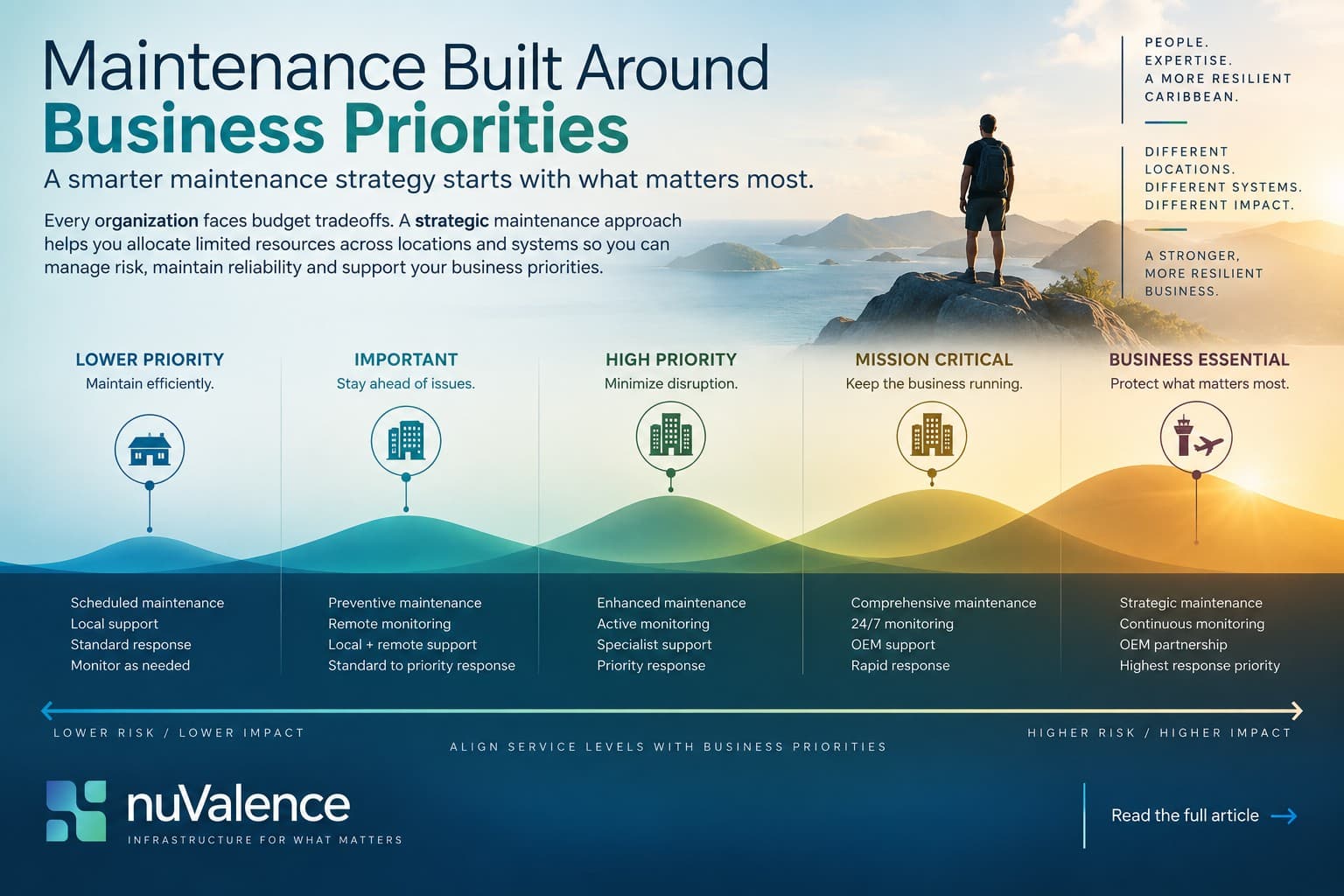
Tiering can occur across three related dimensions.
Location Tiering
Location tiering considers the importance of different facilities within the organization. A flagship resort, core telecommunications facility, data center or major banking location may justify a different service model from a secondary location with lower utilization, greater redundancy or established contingency options.
How important is this location to the organization?
System Tiering
System tiering considers the infrastructure within each facility. Even at a high-priority location, every system does not necessarily require the same response time, monitoring strategy, specialist involvement or contractual deliverables. A hotel, for example, may place particular emphasis on life safety, emergency power, revenue-generating operations, IT and communications, guest-experience technology and central cooling.
How important is this system to the operation of that location?
Support Tiering
Support tiering determines how those locations and systems are maintained. That can include different combinations of preventive maintenance, remote monitoring, local technical resources, specialist support, OEM coverage, critical spare parts and response commitments.
What level of support is appropriate for its role, risk and business impact?
Together, these three dimensions create a practical framework:
- Business Priorities
- Location
- System
- Support
The business defines what matters. The maintenance strategy aligns resources around it.
04Different Service Levels Do Not Mean Neglecting Maintenance
Tiering should not become an excuse to neglect lower-priority infrastructure.
Manufacturer requirements, equipment condition, operating environment, safety, regulatory obligations and appropriate preventive maintenance still need to be considered.
What can change is the service model surrounding the equipment.
That can include:
- Preventive maintenance frequency where appropriate
- Contracted maintenance scope
- Response-time commitments
- Remote monitoring
- Specialist involvement
- OEM service coverage
- Spare-parts strategy
- Reporting requirements
- Local technician responsibilities
- Escalation procedures
A business-critical system may justify comprehensive monitoring, defined response times, critical spare parts, regular specialist involvement and direct OEM support.
Another system may be appropriately supported through scheduled preventive maintenance, local inspections and specialist assistance when required.
Both systems are being maintained. The resources surrounding them are aligned with their importance, risk and consequences of failure.
05Make the Budget Decisions Deliberately
A constrained maintenance budget inevitably creates tradeoffs.
Reducing every maintenance contract by the same percentage may satisfy a budget target, but it does not consider the consequences of failure.
A more deliberate approach considers factors such as:
- Business and revenue impact
- Life-safety implications
- Customer or guest experience
- Regulatory requirements
- Equipment criticality
- Redundancy
- Recovery requirements
- Equipment complexity
- Geographic accessibility
- Availability of local technical resources
- Remote monitoring capabilities
- Cost and availability of specialist intervention
The result may not always be spending less.
For one system, the right decision may be more preventive maintenance.
For another, it may be remote monitoring.
Another may justify keeping critical spare parts onsite.
A particularly important system may require defined response commitments and regular specialist or OEM involvement.
A lower-priority system may be adequately supported through scheduled maintenance and a less intensive service agreement.
The objective is to make those tradeoffs intentionally and direct the available budget toward the areas where failure carries the greatest consequence.
06Decide Where Priority OEM Access Matters
One of the easiest times to underestimate the value of an OEM service agreement is while the equipment is operating normally.
Its value often becomes clearer when a critical system fails.
Without an active service agreement, a customer requesting manufacturer support may enter the OEM's standard commercial service process. Depending on the manufacturer and local market, this can involve normal business-hour response, commercial processing before scheduling, and standard access to technicians and parts.
That process may be acceptable for equipment where the business can tolerate the delay.
It can become a serious constraint when the failed equipment supports a critical operation.
OEM service agreements can provide defined support entitlements such as priority response, technical escalation, preventive service or enhanced parts access, depending on the manufacturer and agreement selected.
This creates another maintenance-budget decision:
Which systems are important enough that the organization should secure priority OEM access before something goes wrong?
It may not be practical to place every asset under the highest level of OEM coverage. For selected critical systems, however, the service agreement can form part of the organization's risk and recovery strategy.
07Geography Changes the Service Model
For organizations operating across the Caribbean, geography adds another constraint.
A hotel group may operate resorts across several islands. A bank may have branches throughout the region. A telecommunications provider may support hundreds of network locations.
A specialist visit may involve airfare, accommodation, ground transportation, travel days and coordination with flight schedules. Weather and transportation disruptions can create additional delays.
The specialist may also be unavailable when the problem occurs.
This makes location tiering particularly important.
Organizations need to determine where expertise should be readily available, where it can be accessed remotely and where trained local resources can provide the first response.
The goal is to spend specialist resources on technical value rather than unnecessarily moving expertise between locations.
08Combine Local Capability With Remote Visibility
Local facility teams and technicians know their buildings, operating environment and what is normal for the facility. They can often reach equipment long before an external specialist.
With appropriate training, documentation, tools and procedures, local resources may be able to perform defined inspections, preventive tasks, basic troubleshooting and diagnostic data collection.
Local capability becomes even more effective when combined with remote monitoring.
Monitoring can provide alarms, equipment status, operating conditions and historical trends without waiting for the next site visit.
That information can help identify developing problems, determine urgency and provide context before someone is dispatched.
A condition affecting a redundant system may require a different response from an alarm threatening a revenue-generating operation, life-safety system or critical infrastructure without redundancy.
Remote monitoring does not replace preventive maintenance or specialist expertise. It gives the people responsible for the infrastructure better information to decide what should happen next.
09Get the Right Information and Expertise to the Problem
Monitoring creates value when information leads to action.
A facility team may need immediate notification of an abnormal condition.
A remote specialist may need operating data and alarm history to begin diagnosis.
Management may need trends showing recurring failures or declining performance.
An OEM may need detailed system information when a problem requires manufacturer-level escalation.
The objective is to get the right information to the right people at the right time.
Technical support can follow a structured escalation path:
- Remote visibility
- Local capability
- Remote specialist support
- Onsite specialist intervention
- OEM or engineering escalation
A routine issue may be resolved locally.
A more complicated problem may require a local technician to work with a specialist remotely.
If physical intervention or advanced diagnostics are required, the specialist can arrive with a better understanding of the problem and potentially the tools or parts required.
When manufacturer-specific expertise is needed, an active OEM support relationship can provide an established path for escalation.
This is support tiering in practice.
10Make the Maintenance Budget Support the Business
A strong maintenance strategy cannot be developed from an equipment list alone.
It starts with understanding what the organization is trying to protect and how those priorities are changing.
The service provider can then work with the customer to translate those priorities into practical decisions about locations, systems and support.
- What generates revenue?
- What affects the customer experience?
- What creates safety or regulatory exposure?
- What cannot be allowed to fail?
- Where does redundancy exist?
- What capabilities does the customer's team already have?
- Which systems justify priority OEM support?
- Where can remote monitoring improve response?
- And where can the organization reasonably accept a different level of support to prioritize resources elsewhere?
The answers will differ for a hotel, bank, telecommunications provider, healthcare facility or government operation. They may also change as the organization becomes more digital and customer expectations evolve.
The goal is not the lowest maintenance cost.
Providing the highest available service level everywhere may be equally unrealistic.
The goal is to allocate available resources in a way that reflects current business priorities while managing reliability and operational risk.
At nuValence, we believe effective infrastructure support starts by understanding what matters most to the customer.
From there, location tiering, system tiering and support tiering can translate those priorities into a practical maintenance strategy.
As business priorities change, the maintenance strategy should be able to change with them.
The objective is to make the available maintenance budget work where it creates the greatest value for the operation.
Frequently Asked Questions
A tiered maintenance strategy aligns different levels of service with the operational importance, risk and support requirements of facilities and infrastructure systems. Tiering can occur across locations, across systems within a facility and in the level of technical support assigned to those systems.
Facility and maintenance teams should work with relevant stakeholders such as operations, IT, finance, procurement, risk, safety and business-unit leadership. The appropriate participants depend on the organization, but the goal is to combine technical knowledge of the infrastructure with an understanding of its impact on the business.
Start with the consequences of failure. Consider business and revenue impact, life safety, customer experience, regulatory requirements, equipment criticality, redundancy and recovery requirements. These priorities can then be used to determine the appropriate maintenance and support model.
An equipment criticality assessment can evaluate the technical consequences of failure, but business impact should also be considered. A system may be important because it supports revenue, customer experience, regulatory compliance or another business-critical function even when the equipment itself is not unusually complex.
OEM coverage should be considered where standard commercial response may not meet the organization's recovery requirements. Depending on the manufacturer and agreement, service contracts may provide defined response commitments, technical escalation, preventive service and enhanced access to parts or specialist resources.
Remote monitoring provides visibility into alarms, operating conditions and equipment status without requiring technical personnel to be continuously onsite. It can support earlier detection, remote troubleshooting and better decisions about when local or specialist intervention is required.
Organizations can tier locations according to business importance, risk, redundancy, accessibility and recovery requirements. Higher-priority facilities may justify more monitoring, faster response, greater specialist availability or enhanced OEM support, while other locations can use a different combination of local and remote resources.
Written by Brandon McCartney, President, nuValence.
All articlesKeep reading
More articles
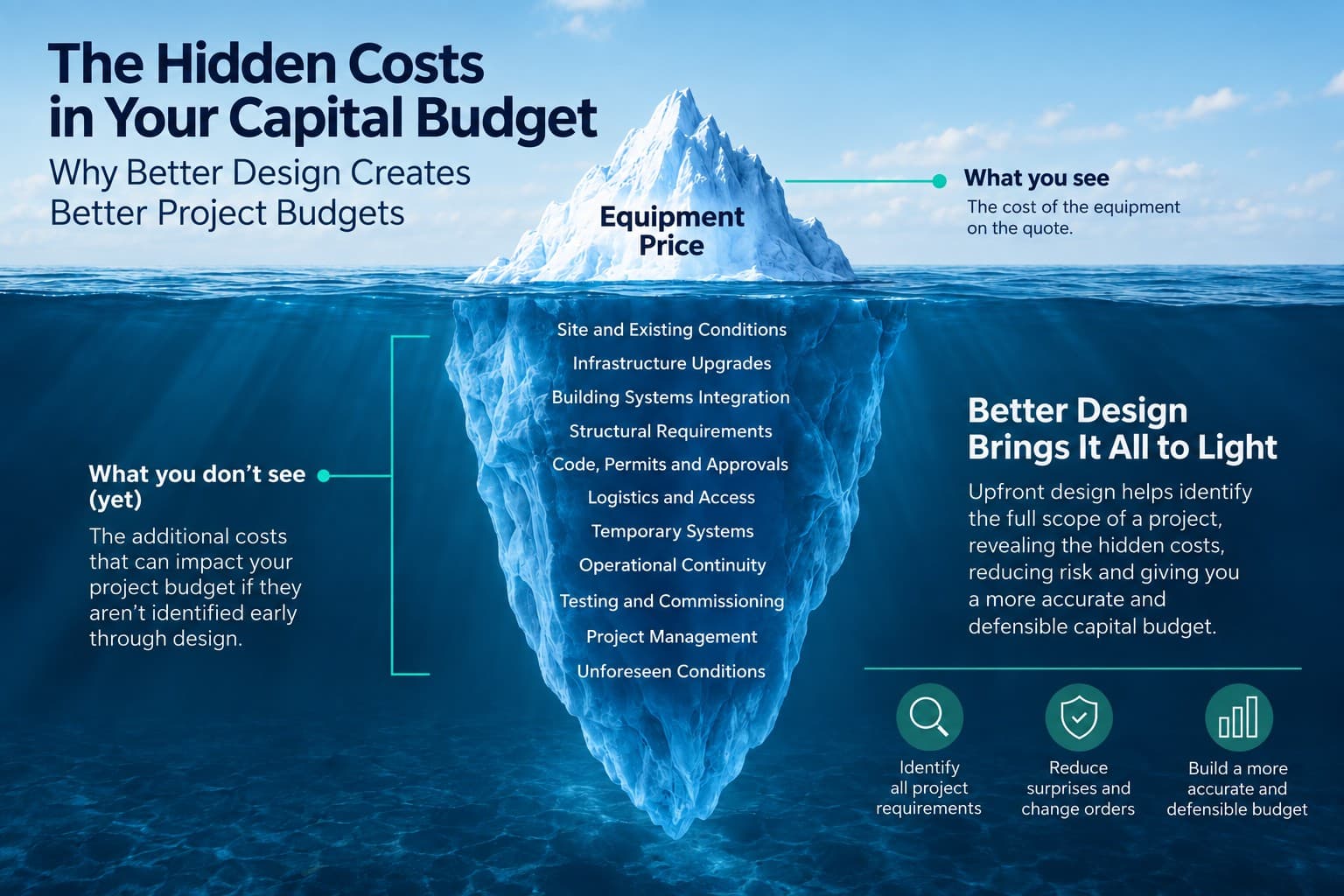 The Hidden Costs in Your Capital Budget: How Design Reveals the Full Project CostWhy early project definition helps facility and procurement teams build more accurate, defensible capital budgets.
 Beyond the Spec Sheet: Why Post-Purchase Support Matters Most in the CaribbeanCapital projects are often evaluated on price and specification. Keeping critical infrastructure operating requires something else entirely: the people, parts, logistics and technical support behind the equipment. In the Caribbean, that difference can be decisive.
Planning infrastructure that has to last?
We will walk through supportability, lifecycle cost and what it takes to keep it running.