

Infrastructure strategy
Beyond the Spec Sheet: Why Post-Purchase Support Matters Most in the Caribbean
Capital projects are often evaluated on price and specification. Keeping critical infrastructure operating requires something else entirely: the people, parts, logistics and technical support behind the equipment. In the Caribbean, that difference can be decisive.
When organizations invest in critical power, cooling, automation and other infrastructure, the evaluation usually begins with familiar questions.
Does the equipment meet the specification? What does it cost? How quickly can it be delivered?
Those questions matter, but they are only the beginning.
A system can be technically excellent and competitively priced and still be the wrong choice for the environment where it will operate. The real question is whether the ecosystem behind that equipment can support it, from getting it onto the island and commissioning it correctly to sourcing a critical replacement part years later.
After more than a decade delivering and supporting infrastructure across the region, we have learned that supportability should be treated as a project specification.
01The CapEx decision becomes an OpEx reality
Capital projects naturally focus on upfront cost. Equipment, importation costs, installation and commissioning are measured against a project budget.
Once the project is handed over, the priorities change.
Facilities and operations teams inherit the consequences of those decisions. They care about uptime, maintainability, response time, parts availability and how quickly a failed system can be returned to service.
A lower purchase price can quickly lose its advantage if specialized technicians are difficult to mobilize, replacement parts are unavailable in your territory or every complex problem depends on overseas support.
The more important question is:
What will it take to own, operate and support this equipment where it will actually be installed?
In the Caribbean, answering that question requires looking beyond the quotation.
02Logistics are part of the technical solution
In large markets, freight, warehousing and inland transportation can feel like commodities. There are often multiple carriers, equipment rental companies and alternative routes available when plans change.
Island markets work differently.
Getting equipment to site may involve a freight forwarder, export documentation, ocean or air freight, customs clearance, brokers, inland transportation and final delivery. Each handoff introduces another dependency.
Import duties and classifications can materially affect project cost as well. Complete equipment and replacement components may be classified differently, creating costs that were never contemplated when the original equipment was purchased.
For larger infrastructure, the challenge becomes physical.
Consider a modular data center arriving on a remote island. Is there a crane capable of lifting it? Can that crane reach the site? Have road widths, bridges, overhead utilities, turning radius and ground conditions been considered?
We supported the commissioning of a modular data center where the equipment's size and weight created exactly this challenge. The technical requirements were available, but the specialized lifting requirement had not been identified early enough. Suitable equipment was not readily available locally, contributing to a project delay measured in years.
The larger lesson was about planning for local constructability.
Local constructability should be considered as part of the infrastructure solution from the beginning.
03Commissioning can determine the project schedule
Specialized infrastructure often requires specialized commissioning, particularly when manufacturer warranty requirements are involved.
We recently supported a chiller replacement where the manufacturer required a factory technician to perform initial commissioning. Before scheduling that technician, the OEM required confirmation that the installation was complete and ready for startup.
That requirement is understandable. Internationally mobilizing a specialized resource to an unprepared site is expensive and inefficient.
The challenge was that the facility's existing chiller was already failing.
The facility needed cooling urgently, while the manufacturer's commissioning process required advance scheduling that could not be accelerated. The end user ultimately had to evaluate whether to wait or assume additional warranty risk by proceeding independently.
For a facility replacing its only operating system, commissioning requirements can materially affect the entire replacement strategy.
Before selecting equipment, understand who can commission it, where those people are located, how far ahead they must be scheduled and what happens to the warranty if another qualified party performs the startup.
04"Parts available" does not always mean available to you
A replacement part existing somewhere in a manufacturer's network does not mean your facility can access it.
Manufacturer support territories do not always follow geography. A Caribbean country may be close to Florida while commercially belonging to a different regional service organization. Parts may physically exist in a US warehouse but be unavailable through the support channel assigned to your territory.
Warranty terms deserve similar scrutiny.
A manufacturer may provide a replacement component under warranty but only deliver it to a designated point in the United States. International freight, brokerage, duties and final delivery may remain the client's responsibility.
Other manufacturers provide far stronger regional support, including international shipment of warranty components and associated logistics.
Neither model is inherently hidden. The problem is discovering which one you purchased only after something fails.
Parts location, territorial access and the actual warranty process should be understood before the equipment is selected.
05The Caribbean is not one technical market
"The Caribbean" does not describe a single electrical or regulatory environment.
Countries and territories have systems shaped by different histories, utilities, standards and construction practices. Across the region, both 50 Hz and 60 Hz systems are in use alongside numerous distribution and utility voltages.
That creates flexibility in equipment selection, but also risk.
Products manufactured for North American, European and other international markets can compete within the same region. When price becomes the primary consideration, equipment may be selected without enough attention to the environment where it will operate.
We have seen equipment supplied for a voltage that did not match the facility where it was intended to be installed. A procurement decision then became a search for additional transformation equipment just to make the purchased system usable.
A supplier's terms may ultimately make the purchaser responsible for confirming compatibility.
A good technical partner should still be asking the questions.
What is the actual electrical service? What voltage and frequency are required? What local requirements apply? Does the selected configuration match the facility?
The objective should be to understand what the client is trying to accomplish before supplying the equipment.
06Specialized expertise has to cross borders too
Sometimes the expertise required to commission or repair specialized equipment does not exist locally.
Every Caribbean jurisdiction has its own immigration and work permit requirements, processing times and costs. International mobilization may also involve travel, accommodation, insurance and significant lost utilization for a specialist spending days away from their home market.
Those costs ultimately become part of the support model.
Not every skill needs to exist on every island. What matters is understanding what happens when local expertise reaches its limit.
Where will additional support come from? How quickly can that person legally and practically reach the facility? What will it cost?
Those questions are much easier to answer before an emergency.
07Nine questions to ask before selecting critical infrastructure
Before making a hardware commitment in the Caribbean, evaluate the support ecosystem with the same discipline used to evaluate the technical specification.
- 1. Who will support the equipment after commissioning?Identify the actual organization and technicians, not just the manufacturer's global capability.
- 2. Where are qualified technicians located?Determine whether support is local, regional or dependent on international mobilization.
- 3. Who is authorized to commission the equipment?Understand startup requirements, lead times and warranty implications.
- 4. Where are critical replacement parts physically stocked?Confirm both the location and whether your territory has access to that inventory.
- 5. What does the warranty actually include?Understand responsibility for freight, brokerage, duties, labor and other costs.
- 6. Which service territory supports your country?Do not assume geographic proximity determines the manufacturer's support organization.
- 7. What specialized tools, software or credentials are required?Make sure the people maintaining the system can access what they need.
- 8. Can the equipment physically reach and be installed at the site?Consider dimensions, weight, lifting requirements, inland transportation and local resources.
- 9. What happens when local support reaches its limit?Establish a clear escalation path to manufacturer-level expertise.
The objective is clear:
Understand the support path before you own the failure.
08The strongest support model combines local and manufacturer expertise
Manufacturer support and local expertise should not be viewed as alternatives.
A global manufacturer brings product engineering, specialized training, factory resources, parts networks and technical escalation. A capable local or regional partner brings proximity, knowledge of local conditions, logistics experience, local technical expertise and the ability to respond quickly.
The strongest model connects both.
At nuValence, we value manufacturer relationships that extend beyond access to a product catalogue. Training, technical tools, parts availability, warranty processes and direct escalation all influence which technologies we are comfortable supporting.
Some manufacturers have built Caribbean support models that closely resemble those available in major markets. Others depend heavily on international mobilization or regional distribution.
Understanding that difference is part of equipment selection.
The manufacturer's name on the enclosure matters. The support structure behind it matters just as much.
09Reliability starts before the first failure
Post-purchase support should begin long before something fails.
During design and selection, consider whether the equipment can be maintained locally, which critical spares should be held, what remote diagnostic capabilities are available and how the system will be monitored and maintained.
Commissioning establishes a known starting point. Preventive maintenance helps identify deterioration. Monitoring provides visibility between service visits. Accurate asset records preserve history. Local technical capability provides the first response, with manufacturer expertise available when escalation is required.
Reliability depends on all of these elements working together.
10Why nuValence approaches equipment selection differently
nuValence approaches infrastructure as a solution provider rather than a hardware seller.
Our home market, The Bahamas, includes hundreds of islands and cays. Delivering infrastructure here has required us to navigate international and inter-island logistics, customs, limited local resources, specialized lifting requirements, replacement parts and manufacturer support constraints. We have carried those lessons into projects throughout the Caribbean.
That experience changes the conversations we have before equipment is ordered.
We want to understand where the equipment will operate, what it supports, what happens if it fails, who will maintain it, what expertise exists locally and how the manufacturer will respond when additional support is required.
Sometimes our role is to supply and deliver the solution. Other times, the greatest value we can provide is asking the right questions, validating the details and helping a project team make a better decision before committing to hardware.
11Buy the support ecosystem, not just the equipment
A specification can tell you capacity, efficiency, dimensions and performance.
It cannot tell you how difficult it will be to find a crane on a remote island, whether the closest parts depot serves your territory, how quickly a specialist can reach your facility or whether the equipment being shipped matches the infrastructure waiting for it.
Those details can determine the success of the investment just as much as the technical specification.
For critical infrastructure in the Caribbean, supportability is not something to consider after procurement.
It is part of the design.
Technical performance, price and specification all matter. So do the people, parts, logistics and support required to keep that equipment operating.
The right infrastructure solution is one that can be delivered, supported and depended upon where it actually operates.
Written by Brandon McCartney, President, nuValence.
All articlesKeep reading
More articles
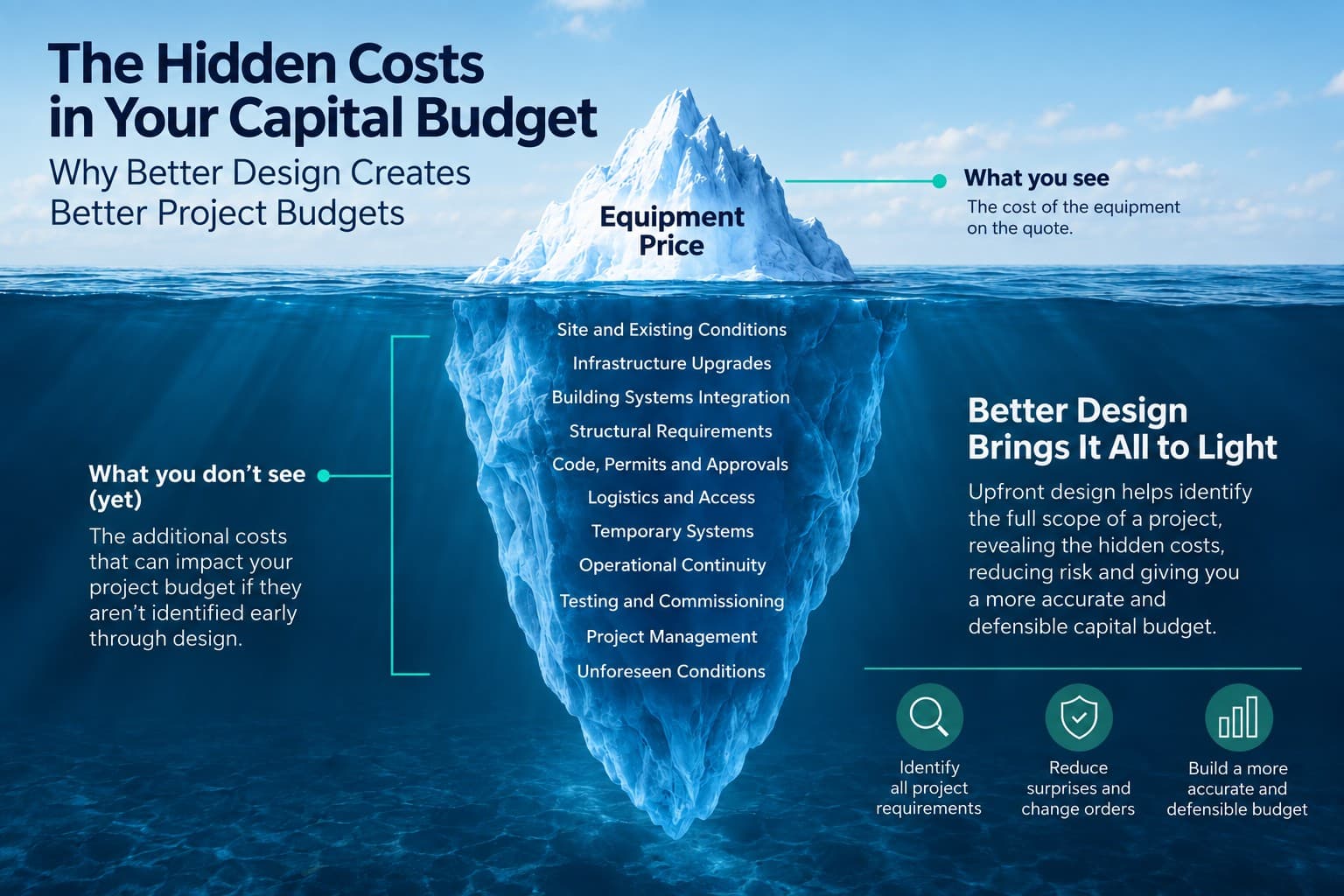 The Hidden Costs in Your Capital Budget: How Design Reveals the Full Project CostWhy early project definition helps facility and procurement teams build more accurate, defensible capital budgets.
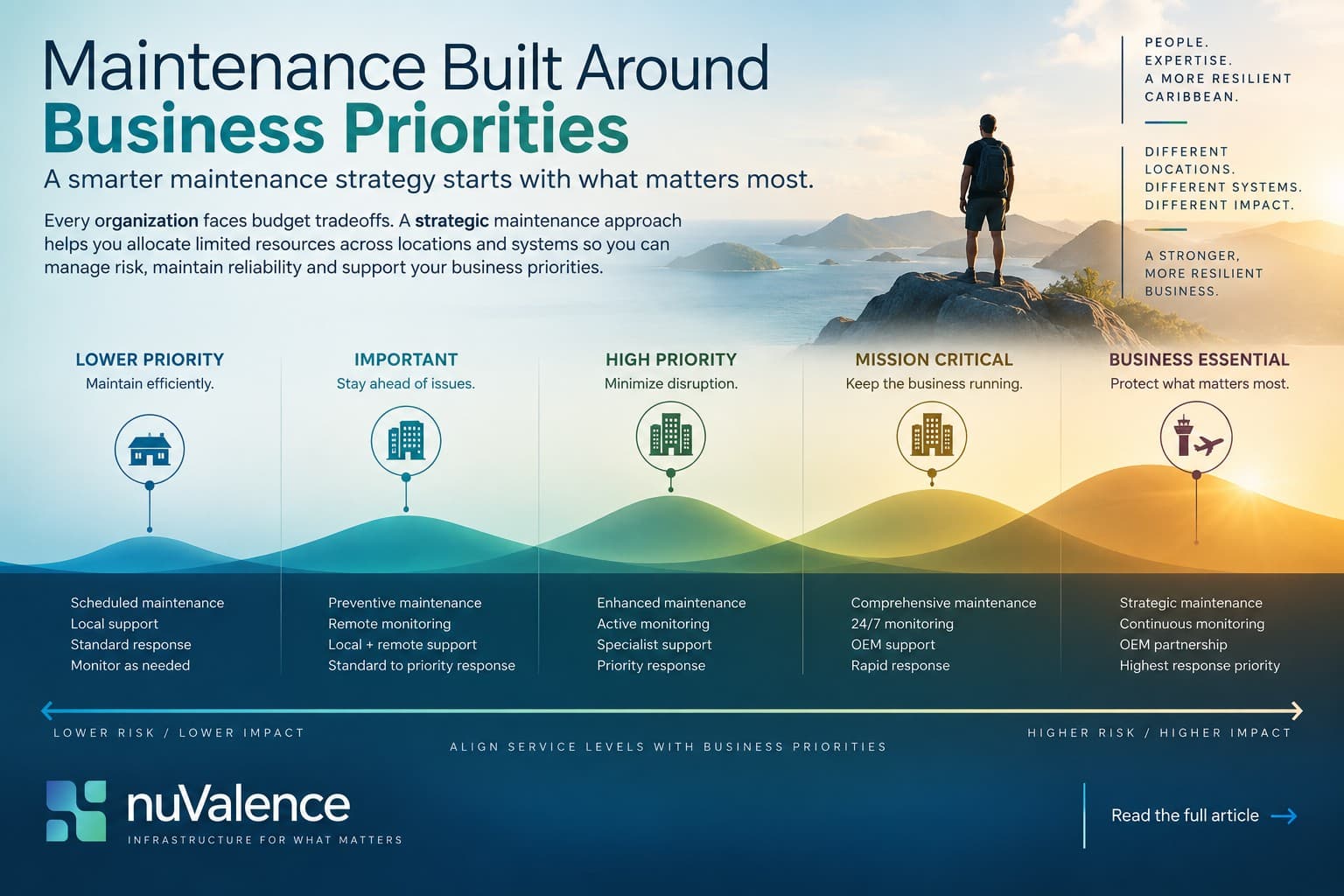 Making Maintenance Budgets Work Harder: A Smarter Maintenance StrategyHow stakeholder priorities, location, system and support tiering can make limited maintenance budgets work harder.
Planning infrastructure in the Caribbean?
Whether you are developing a new project, evaluating competing equipment or replacing an existing critical system, nuValence can help evaluate the technical, logistical and support requirements before a hardware commitment is made.